Join Ladbrokes Races.com.au Favourite Bookmaker!
Join Ladbrokes through Races.com.au and be ready when the gates open.

Code used for tracking purposes only.
Chances are you’re about to lose. For free and confidential support call 1800 858 858 or visit gamblinghelponline.org.au
Join Ladbrokes Races.com.au Favourite Bookmaker!
Join Ladbrokes through Races.com.au and be ready when the gates open.
Code used for tracking purposes only.
Chances are you’re about to lose. For free and confidential support call 1800 858 858 or visit gamblinghelponline.org.au
Melbourne Cup Form Guide News
- Melbourne Cup 2026 Late Mail: Race Day Tips, Market Movers & Final Predictions for the ‘Race That Stops a Nation’
- Melbourne Cup 2026 Speed Map & Predictions: Brutal Staying Test Set to Shape Flemington Race 7
- Melbourne Cup 2026 Scratching Bombshell: Asterix Officially Withdrawn on Stewards Orders
- Race Day Melbourne Cup 2026 Odds Shock: Hopewell Rock Storms into Favouritism as Point Of Law Drifts
- Melbourne Cup 2026 Jockey Drama: Harry Coffey Cleared for Shockletz as Michael Dee Left Without a Ride in Stunning Cup Twist
2026 Melbourne Cup Results
The 2026 Melbourne Cup results will be known when the race runs on .
- #20 Point Of Law
- #15 Zahrann
- #11 Juja Kibo
Winning Margin: 3.75 lengths
Winning Time: 3:21.88
Winning Barrier: 8
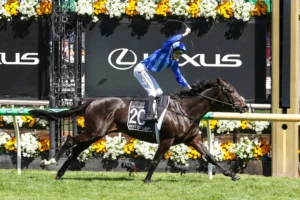
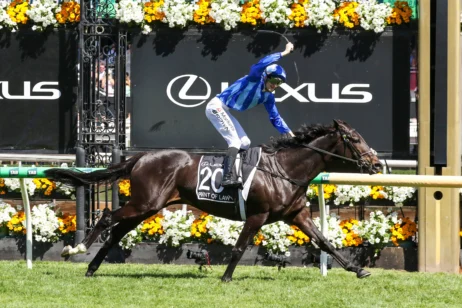
The 2026 Melbourne Cup results produced a race domination for trainer Ciaron Maher, who saddled the trifecta in the 166th running of Australia’s greatest race. Geelong Cup winner Point Of Law ($7F) continued his meteoric rise with a stunning victory under Ethan Brown, becoming the most lightly raced Melbourne Cup winner in history at just his sixth career start. The progressive son of Frankel stormed home to defeat stablemates Zahrann and Juja Kibo, while Irish raider Sons And Lovers finished fourth. The victory also completed the coveted Geelong Cup-Melbourne Cup double, the first since Dunaden in 2011, and delivered Maher his second Melbourne Cup triumph following Gold Trip’s success in 2022.
Click here for the full story.
2026 Melbourne Cup Race Replay
The Melbourne Cup 2026 form guide is the ultimate resource for punters analysing the field for Australia’s most famous horse race, providing a comprehensive breakdown of every runner contesting the prestigious Group 1 Melbourne Cup (3200m) at Flemington. As the ‘race that stops a nation’, the Melbourne Cup attracts an elite line-up of local stayers, international raiders, proven Group 1 performers, and emerging Cups contenders, making detailed form analysis essential for identifying the horses most likely to excel over the famous two-mile journey. The latest Melbourne Cup 2026 form guide includes each runner’s recent performances, handicap weight, barrier draw, jockey and trainer details, distance record, track statistics, career earnings, and key lead-up form from races such as the Caulfield Cup, Geelong Cup, The Bart Cummings, Moonee Valley Gold Cup, and major European staying features.
For serious punters, the Melbourne Cup form provides valuable insight into the strengths and weaknesses of every contender, helping separate genuine winning chances from the rest of the field. On this page, you’ll find the official Melbourne Cup form guide, expert race analysis, runner-by-runner profiles, betting insights, and key statistics designed to help you assess the field and uncover value in the Melbourne Cup betting markets ahead of Australia’s greatest racing spectacle.
Melbourne Cup 2026 Form Guide: Runner-by-Runner Analysis & Predictions
Melbourne Cup 2026 Horses Form: Two Words on Each Runner
2026 Melbourne Cup Field & Form Guide
The official Melbourne Cup 2026 field and form guide will be provided below here once final acceptances are released on VRC Derby Day the Saturday prior to the race.
FULL 2026 MELBOURNE CUP FORM GUIDE
Melbourne Cup 2026 Results
| 20. Point Of Law (9) 53kg141×1 | |||
| 15. Zahrann (11) 54.5kgx4106 | |||
| 11. Juja Kibo (14) 55kgx3211 | |||
| 1. Sons And Lovers (3) 57.5kg44512 | |||
| 7. Royal Supremacy (21) 56kg1×910 | |||
| 24. Shockletz (17) 51kg64162 | |||
| 18. James J Braddock (24) 53.5kg136×6 | |||
| 16. So You Are (7) 54kg21111 | |||
| 12. Hopewell Rock (15) 54.5kg3612x | |||
| 4. Middle Earth (1) 56.5kg87898 | |||
| 2. Trustyourinstinct (18) 57kg21214 | |||
| 3. Knight’s Choice (2) 56.5kgx0930 | |||
| 14. Soul Of Spain (5) 54.5kg68378 | |||
| 23. Zakouma (10) 52kgx6650 | |||
| 6. Enfjaar (8) 56kg381×3 | |||
| 19. Kizlyar (20) 53.5kg1x2x0 | |||
| 22. Mr Monaco (16) 52.5kgx4013 | |||
| 21. Strictly Business (4) 53kg2×000 | |||
| 8. Wine Dark Sea (23) 56kg151×0 | |||
| 17. Future History (12) 53.5kgx3249 | |||
| 13. Onesmoothoperator (13) 54.5kg9×090 | |||
| 10. Goodie Two Shoes (19) 55kgx8210 | |||
| 5. Vauban (22) 56.5kg133×9 | |||
| 9. Asterix (6)SCRATCHED: | |||
The Melbourne Cup form guide is the master reference punters use to assess every runner in Australia’s most famous race. It brings together the key data points that matter in a gruelling 3200 metre staying test at Flemington — recent performances, distance credentials, weight, barriers, international form, and how each horse is likely to map. Because the Cup is a unique blend of stamina, timing, tempo and luck, the form guide helps punters cut through the noise and identify which runners are genuinely suited to the race.
What Punters Should Look for in the Melbourne Cup Form Guide:
- Staying credentials — The Cup is a true two-mile test, so look for horses proven at 2400m-3200m or those with strong late strength in high-pressure races.
- Weight and handicapping — The Melbourne Cup is a handicap, and the weight a horse carries can make or break its chances. Lightly weighted improvers and well-treated internationals often profile well.
- Lead-up form — Traditional pathways like the Caulfield Cup, Bart Cummings, Moonee Valley Gold Cup and international staying races (Ebor, Kergorlay, Irish St Leger) are strong indicators of Cup suitability.
- Flemington performance — Horses proven down the long Flemington straight or those who finish strongly at spacious tracks tend to be advantaged.
- Barrier draw — While not as critical as in shorter races, wide gates can force runners to work early, while inside draws can help midfield horses settle comfortably.
- Race tempo and map — Understanding where each horse is likely to settle is crucial. On-speed runners need to stay the trip; backmarkers need a genuine tempo and clear running lanes.
- International form lines — Overseas stayers often bring elite staying profiles. Punters should compare their ratings, sectionals and race conditions to Australian standards.
- Track conditions — Some Cup contenders excel on firm ground, while others improve dramatically on soft going.
- Trainer and jockey patterns — Cup winning stables and riders often target the race with precision, and their history in major staying races can be a key factor.
Want to discover value runners using smart form suggestions?
Form Genius is a powerful form analysis tool that makes doing the form easy by getting through mountains of data at the touch of a button! Ask it anything and get fast, form-based answers on any runner, jockey or trainer in any race. Use the smart prompts for deep insights and to sharpen your punting even further.

Ask Form Genius...
- Which runner has the best trainer/jockey combo at Flemington?
- Which runner has the best form on this track?
- Which runners are mapped as leaders in the Melbourne Cup?
Want to discover value runners using smart form suggestions?
Form Genius is a powerful form analysis tool that makes doing the form easy by getting through mountains of data at the touch of a button! Ask it anything and get fast, form-based answers on any runner, jockey or trainer in any race. Use the smart prompts for deep insights and to sharpen your punting even further.
Get Free Access to Form Genius NowDetailing all the facts and stats you need to know to place a winning Melbourne Cup bet, the Melbourne Cup form guide is a detailed breakdown of the field.
Info you will find in the 2026 Melbourne Cup form guide includes:
- Melbourne Cup Barriers – what horses will jump from what gates
- Melbourne Cup Saddlecloth Numbers – the saddlecloth number each horse will wear
- Melbourne Cup Jockeys – the jockeys that will ride each contender
- Melbourne Cup Trainers – which trainer is behind the horse you are backing
- Melbourne Cup Weights – the handicap weight allocated to all the hopefuls
These are just some of the basic Melbourne Cup field and race information listed in a general Melbourne Cup form guide.
A more detailed Melbourne Cup form guide will include additional details of other important statistics, such as:
- Win and Place rates for each horse
- Last 6-10 runs by each horse
- First-up and Second-up records of the gallopers
- The Track & Distance records for the horses
If you are unfamiliar with how a form guide works, this article will help you understand the information found on the Melbourne Cup form guide so that you can make smarter picks.
Melbourne Cup Form Guide Facts
Melbourne Cup Trainers: Lee Freedman boasts five Melbourne Cup wins in the past 30 years so watch for Melbourne Cup horses from the Freedman stable in the 2026 Melbourne Cup Field. The Freedman family won a fifth Melbourne Cup with Anthony & Sam Freedman training Without A Fight for his 2023 success.
Melbourne Cup Jockeys: Damien Oliver, Glen Boss and Kerrin McEvoy have all ridden three Melbourne Cup winners in the past 30 years so placing a 2026 Melbourne Cup bet on an in-form stayer with one of these hoops in the saddle could be a winning Melbourne Cup tip.
Melbourne Cup Barriers: The most successful Melbourne Cup barrier in the past 30 years producing four winners is barrier 11. Keep an eye out on the 2026 Melbourne Cup barrier draw released on VRC Derby Day on the Saturday before Melbourne Cup Day.
Melbourne Cup Favourites: Since 2005 the only Melbourne Cup favourites to salute for the punters are Fiorente ($7 in 2013) and Point Of Law ($7 in 2026) so looking at gallopers further down the 2026 Melbourne Cup betting markets is a better bet.
How to Read a Melbourne Cup Form Guide
Form guides are not entirely standard – one site may include more statistics, another might have information on how a horse ran in their last 6 races – but they tend to use similar terminology and abbreviations.
The following are commonly included statistics in a Melbourne Cup form guide that could have an effect on your bet. Entries on miscellaneous information have been omitted, as information such as horse colour will have no effect on your bet.
Saddlecloth Number – This is simply the number of the horse, which can be needed to place your bet.
Barrier – This is the barrier number that the horse will start in, usually presented as a number in brackets after the horse name.
Weight – The weight the horse will carry, this may be given its own section or may be found directly after the barrier number, weights are in kilograms, and you should look for a number less than 56kg.
Age and Sex – These are normally found together. Age will usually read “7yo”, and sex will either be written in full or abbreviated to the first letter. Sexes are Horse (full stallion of 4 years or older), Colt (male of 3 years or less, intact), Filly (female of 3 years or less), Mare (female of 4 years or older), or Gelding (castrated male horse).
Remember to look on your Melbourne Cup form guide for 4 and 5 year old full horses and geldings. These runners are statistically the most likely to win, while fillies and colts have not performed well in recent years. Mares can be worthwhile if they have proven themselves in other races.
Pedigree – The sire and dam of the horse. Can indicate the type of run that the horse is best suited to, as stayers tend to produce stayers and sprinters produce sprinters. This is often listed as just two horse names separated by a dash.
Form/Last 6 – This is the string of numbers and letters you see listed next to a horse’s name. It indicates at a glance how the horse performed in its last 6 runs, with the most recent result being the number on the far right.
Numbers from 1 to 9 indicate a finish in that position, while a 0 indicates a finish behind ninth place. Letters and symbols indicate falls, throws and other mishaps. Many online betting sites provide full race details, so there is little need to memorise all the symbols if you are just betting on the Melbourne Cup, as you can read the full race summary for the horse at sites like Ladbrokes.
Career – This is the number of races the horse has run and the numbers of wins, seconds and thirds. It is presented in a format of – Total Starts: Wins Seconds Thirds. An example is 5: 2 0 1 which would indicate a horse that has 5 starts with 2 wins, 0 second placings, 1 third placing, and the other starts not being place finishes.
Trainer – A horse’s trainer is very important, and you will generally want to support runners that come from one of the top Australian trainers. Bart Cummings is the most successful trainer of Melbourne Cup winners, with 12 wins from 1965 to 2009. Lee Freedman is the next most successful in the modern era, with 5 wins from 1989 to 2005.
Jockey – Despite what beginners think, a skilled jockey is vital to a horse’s success in the Melbourne Cup. If you don’t know anything about the jockey, check to see if the horse has any previous experience with that rider. It’s a good sign if the jockey has taken that horse to wins over similar distances before.
Fast/Good/Dead/Slow/Heavy/Wet – These are all different track conditions, and the statistics for them are similar to the Career stat, i.e. Wins Seconds Thirds, in those specific track conditions. If the track conditions on Melbourne Cup Day are unfavourable for your runners, you will need to rethink the kinds of bets you will make.
First Up – How the horse has performed in their first race after a long break, written like the Career statistic. This won’t matter much in a Melbourne Cup form guide, as all the contenders will have raced many times in the weeks prior to the Cup.
next to go